

The Reparative Memory Framework: Turning Community Memory into Civic Infrastructure
By Barbara Mumby Huerta

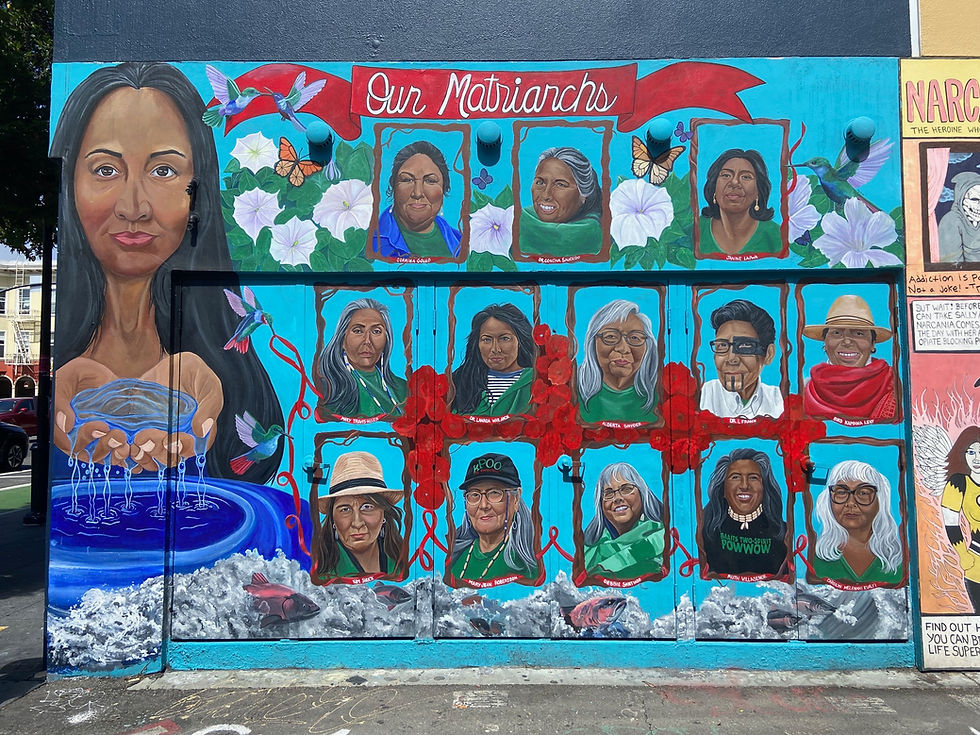
(2023)
Oil on canvas
40”x28”
In moments of social fracture—when communities experience political polarization, cultural erasure, displacement, and generational trauma—one question becomes unavoidable: What happens when memory itself is broken?
Memory is not simply personal recollection. It is the living archive of a community’s values, struggles, resilience, and knowledge. When collective memory is erased, distorted, or extracted without care, communities lose more than stories—they lose the connective tissue that allows them to understand who they are and how they belong to one another.
For many Indigenous, diasporic, and marginalized communities, this disruption of memory is not accidental. It is structural. Colonization, forced migration, racialized policy, and cultural extraction have repeatedly separated people from their histories and from the institutions that claim to represent them.
Over the past several decades of work across child advocacy, cultural policy, and public art, I have sought ways to address this fracture not only through storytelling but through systems design.
This work led me to articulate what I now call the Reparative Memory Framework—a methodology that treats memory as civic infrastructure and positions art as a tool for collective repair.
Why Memory Matters
Many institutions approach community engagement through documentation: oral histories, exhibitions, surveys, archives. These practices are often well-intentioned, yet they can inadvertently reproduce extractive dynamics.
Communities share their stories. Institutions collect them.But the underlying systems that caused harm often remain unchanged.
The result is a paradox: stories are preserved, yet the structural conditions that silenced those stories continue.
The Reparative Memory Framework begins from a different premise:
Memory should not only be preserved—it should be activated in ways that repair relationships, redistribute visibility, and strengthen collective futures.
Rather than treating memory as a static artifact, the framework treats it as a living civic resource.
Defining the Reparative Memory Framework
The Reparative Memory Framework (RMF) is a trauma-informed, community-led methodology that transforms suppressed histories and intergenerational knowledge into public rituals, images, and systems that communities can steward beyond the artwork itself.
At its core, RMF proposes that art can function as a form of civic infrastructure—a mechanism for restoring connection, affirming dignity, and strengthening cultural continuity.
The framework is rooted in five interrelated principles.

Five Principles of the Reparative Memory Framework
1. Memory as Evidence
The lived experiences of communities—particularly those historically marginalized—should be recognized as forms of civic knowledge.
Rather than privileging institutional narratives alone, RMF centers the memories held within families, neighborhoods, and cultural networks. These memories become evidence of both historical harm and enduring resilience.
2. Community Authorship
Too often, cultural institutions invite communities to participate only after decisions have already been made.
RMF prioritizes co-creation from the beginning. Participants are not subjects of a project; they are authors of the narrative and stewards of its meaning.
This shift transforms engagement from consultation into shared leadership.
3. Public Witnessing
Repair requires visibility.
When communities gather to witness one another’s stories—through murals, exhibitions, performances, or ceremonies—something powerful occurs. Experiences that were once isolated become collective.
Public witnessing transforms memory into a shared civic act.
4. Structural Reciprocity
Artistic engagement must extend beyond symbolic representation.
RMF emphasizes reciprocity—ensuring that participants receive tangible benefits, resources, and visibility from their contributions. This might include compensation, leadership opportunities, or institutional partnerships that outlast the project itself.
Reciprocity ensures that storytelling does not become another form of extraction.
5. Intergenerational Continuity
Repair is not instantaneous.
Projects grounded in RMF are designed to carry meaning across generations. They recognize that elders, cultural bearers, youth, and emerging leaders all hold pieces of a community’s narrative.
When these voices are brought together, memory becomes a bridge between past and future.
Reparative Memory in Practice
While the Reparative Memory Framework provides a conceptual model, its value lies in how it operates within real communities and institutions.
Across my career, several initiatives have embodied these principles in different ways.
Hands On Heroes: Recognizing Community Care
In 2010, while working with First 5 Merced County, I created the Hands On Heroes Program, inspired by the county’s Children’s Bill of Rights.
The program honored individuals and businesses who went above and beyond to support children—from prenatal care through adolescence—often without public recognition.
By inviting community members to nominate these unsung champions and celebrating them publicly, the program reframed the narrative around child wellbeing. Instead of focusing solely on risk factors, it highlighted resilience, care, and everyday leadership.
Recognition became a form of restorative visibility.
Cultural Ambassador Program: Rebuilding Trust in Public Systems
Later, while serving with the San Francisco Arts Commission, I designed the Cultural Ambassador Program to address disparities in arts grant participation among marginalized communities.
Rather than expecting artists to navigate bureaucratic systems alone, the program partnered with trusted community connectors who could provide guidance, translation, and encouragement.
The result was a dramatic increase in applications from historically underrepresented communities, demonstrating that structural barriers—not lack of talent—were the primary obstacle.
This approach reflects RMF’s principle of structural reciprocity: systems must meet communities where they are.
The Ebony McKinney Arts Leadership Award
Recognition also plays a crucial role in repairing cultural ecosystems.
Following the passing of arts leader Ebony McKinney in 2017, I conceptualized the Ebony McKinney Arts Leadership Award to honor administrators addressing critical equity issues within San Francisco’s arts community.
The award ensures that leaders working behind the scenes—often women and leaders of color—receive visibility and institutional support.
It transforms remembrance into action.
The Artistic Legacy Grant
Cultural memory is also carried through artists whose work spans decades.
The Artistic Legacy Grant (ALG) was developed to celebrate artists who have contributed to San Francisco’s cultural life for 25 years or more. Recipients such as Alleluia Panis, Patrick Makuakane, Joan Pinkvoss, and Rhodessa Jones exemplify how artistic practice becomes a form of cultural stewardship.
Through recognition and celebration, institutions affirm the value of long-term creative contribution.
Public Art as Civic Infrastructure
The Reparative Memory Framework ultimately invites institutions to reconsider the role of art in public life.
Art is often framed as enrichment—something that enhances a community’s quality of life.
But art can also function as infrastructure.
Just as roads connect neighborhoods and schools educate young people, cultural practices connect communities to their histories, values, and futures.
When memory is honored, communities gain clarity about who they are.When stories are witnessed, trust grows. When contributions are recognized, leadership expands.
Repair becomes possible.
Why This Work Matters Now
Across the United States and beyond, communities are grappling with questions of belonging, justice, and identity.
Institutions increasingly recognize the need for equity but often struggle to translate values into practice.
The Reparative Memory Framework offers one pathway forward.
By centering community memory, co-creation, public witnessing, reciprocity, and intergenerational continuity, the framework transforms art from representation into relationship.
It asks institutions to do more than document communities.
It asks them to repair with them.
Looking Ahead
The future of civic art lies not only in new images but in new systems—systems that acknowledge historical harm while building structures capable of sustaining dignity and connection.
The Reparative Memory Framework is one attempt to articulate how this work can happen.
Because when memory is restored, communities do more than remember.
They rebuild.
About the Author
Barbara Mumby Huerta is an interdisciplinary artist, cultural strategist, and equity-centered systems leader. Her work bridges public art, cultural policy, and community engagement, exploring how memory, storytelling, and creative practice can function as tools for collective healing and civic repair.


Comments